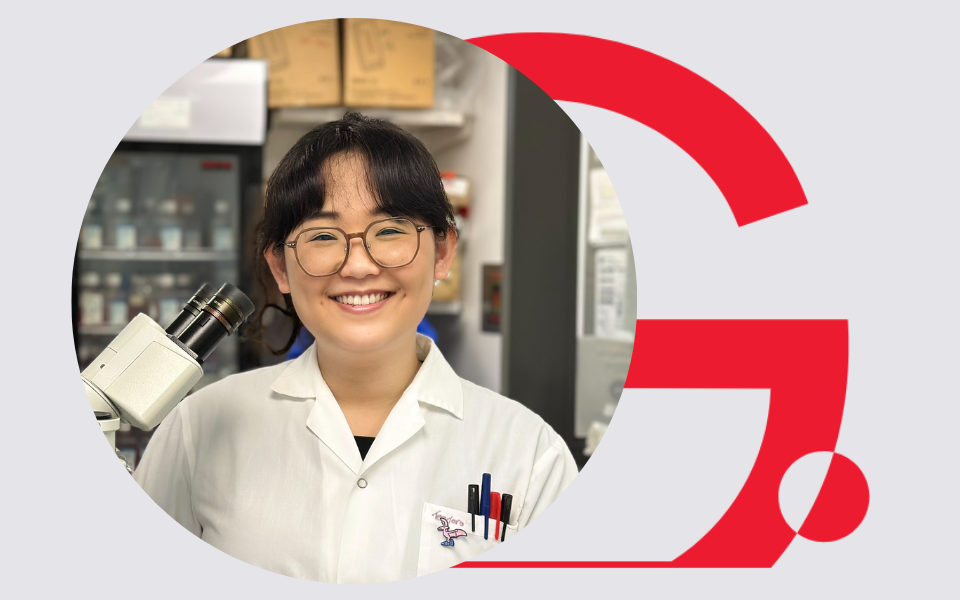
In honour of Colorectal Cancer Awareness Month, the Rosalind & Morris Goodman Cancer Institute (GCI) is highlighting the work of trainees whose research is advancing our understanding of cancer and improving the future of patient care. Today, we feature Yilin Wang, a PhD candidate in Biochemistry in the laboratory of Professor José Teodoro, whose research explores an important biological link between inflammatory bowel disease (IBD) and colorectal cancer.
Colorectal cancer is one of the most common cancers worldwide and remains the third leading cause of cancer-related death among Canadian men and women. While the disease can often be prevented or treated when detected early, many patients experience debilitating symptoms such as rectal bleeding, abdominal pain, fatigue, and chronic digestive issues.
For individuals living with inflammatory bowel disease — including Crohn’s disease and ulcerative colitis — the risk of developing colorectal cancer is significantly higher. Yet the biological mechanisms connecting chronic inflammation and cancer development remain poorly understood. This is where Yilin’s research comes in.
The molecular connection: lipids and inflammation
Patients with IBD face a significant higher risk of developing and succumbing to colorectal cancer. Yilin’s doctoral research identifies a crucial commonality between these two conditions: altered lipid levels.
“My doctoral research focuses on how altered lipid breakdown affects both diseases at the molecular level,” Yilin explains.
By studying a specialized family of lipids and their breakdown pathways, the goal is to uncover new therapeutic targets. This approach aims to go beyond treating symptoms; by targeting lipid metabolism, researchers hope to actively reduce the persistent inflammation that drives disease progression and cancer development.
A collaborative ecosystem
Scientific innovation rarely happens in a vacuum, especially at the GCI. Yilin’s work is a good example of a “bench-to-bedside” approach. A critical component of her research involves close collaboration with gastroenterologists and clinical researchers at the Montreal General Hospital to obtain colon biopsies from IBD patients. These patient samples are essential for ensuring the research has a direct translational impact.
The GCI Core Facilities are also fundamental in advancing Yilin’s research. Close collaboration with the Metabolomics Innovation Resource (MIR) allowed for a precise quantification of anti-inflammatory lipids, essential to lay the bases of Yilin’s project. In addition, Yilin has benefited from support from the Histology Core Platform, the McGill Integrated Core for Animal Modeling, the Flow Cytometry Core Facility, the BIOBAR and GCI Research Support.
These collaborations highlight the GCI’s dedication to supporting groundbreaking research and pushing research fields like Yilin’s to personalized medicine.
Supporting the future of research
Yilin’s impactful work is made possible through the support of several prestigious funding bodies and awards: FRQS and FRQNT Doctoral Scholarships, Rolande and Marcel Gosselin Graduate Studentship, Mitacs Globalink Graduate Fellowship Award, Canderel Travel Award, Cancer Research Society Operating Grants, Owen Catchpaugh Grant for Innovative IBD Research.
As we highlight Colorectal Cancer Awareness Month, we look towards a future where groundbreaking research such as Yilin’s offers hope for a new generation of therapies that are as precise as they are effective.

Rosalind & Morris Goodman Cancer Institute all rights reserved • Privacy policy • Accessibility
Website by Riposte