


Breast Cancer Awareness Month: New GCI Study Identifies a Way to Stop Early Breast Cancer from Spreading
October 22 2026
Breast cancer is the most diagnosed cancer in women in Canada, and 1 in 8 women will receive a diagnosis in their lifetime. October is Breast Cancer Awareness Month, an opportunity to reflect on the progress made and the work still needed to reach a cancer-free world.
This year, the Rosalind & Morris Goodman Cancer Institute (GCI) is highlighting a new study on early breast cancer by GCI researcher William Muller and his team. The study reveals a new therapeutic target that could help clinicians better treat and prevent invasive disease.
Why early breast cancer matters: ductal carcinoma in situ
The earliest form of breast cancer, known as stage 0, is also called ductal carcinoma in situ, or DCIS. In DCIS, abnormal cells are found inside the milk ducts but have not yet spread into the surrounding breast tissue. DCIS accounts for up to 25% of all new breast cancer diagnoses. An estimated 10-50% of these patients will develop invasive disease if left untreated.
The major challenge for researchers and clinicians is confidently knowing which patients will go on to develop invasive cancer and which will stay at the early stage. Because doctors cannot tell the two groups apart, all patients are often given relatively aggressive treatment, including surgery and radiation, even though some would never have progressed. Being able to identify the patients at risk of progression would spare the others unnecessary treatment, improving the quality of live and easing the burden of care.
A new way to identify patients at risk of invasive disease
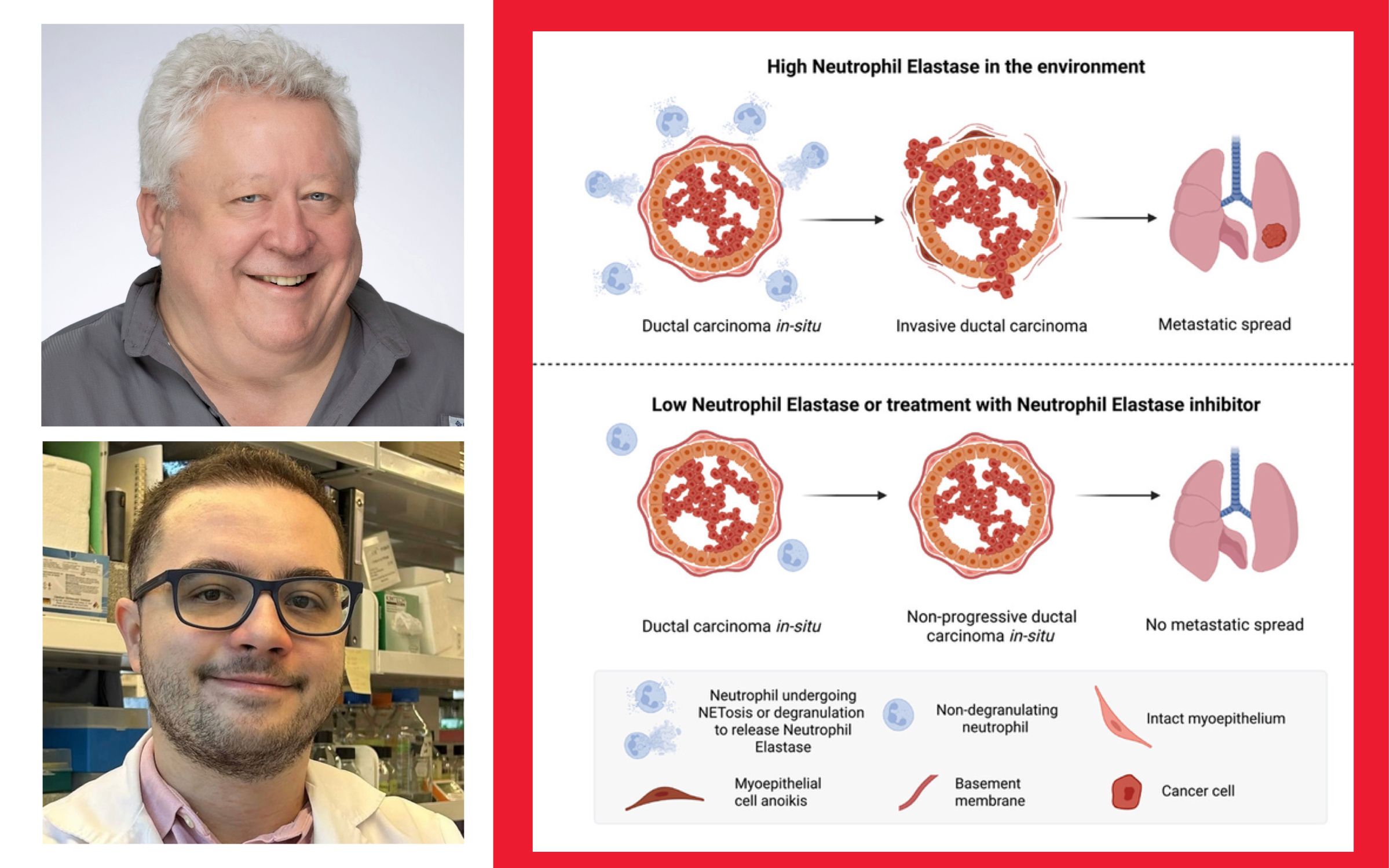
Prof. William Muller and his team, led by MD-PhD student Tarek Taifour, have identified a new way that DCIS becomes invasive breast cancer. Published in Cell Reports Medicine, the study, titled Neutrophil elastase-mediated myoepithelial loss is a therapeutic vulnerability in ductal carcinoma in situ progression looks at two key players: myoepithelial cells, which act as a protective barrier against invasive cancer, and an enzyme called neutrophil elastase, which leads to myoepithelial loss.
Myoepithelial cells form a single layer of cells around the milk duct, where most breast cancers begin. This layer acts like a wall, keeping cancer cells from invading the surrounding tissue. Losing this wall is an essential step in the progression to invasive breast cancer.
Tarek and his colleagues identified neutrophil elastase, an enzyme released by immune cells called neutrophils, as a major threat to myoepithelial cells. The enzyme breaks down the thin membrane that surrounds and supports them. Neutrophils are among the immune system’s first responders to infection, usually targeting invaders such as bacteria or fungi. The research team found that blocking neutrophil elastase in laboratory cell cultures (in vitro) and in living animals (in vivo) restored the myoepithelial layer and prevented the cancer from progressing and spreading to other parts of the body (metastasis).
The authors also found much higher levels of neutrophil elastase in early breast cancer patients whose cancer later spread than in patients whose cancer did not. Patients whose tumours contained high levels of the enzyme also had poorer outcomes.
These results suggest that neutrophil elastase could be a new treatment target for breast cancer. It could also serve as a biomarker (a measurable biological signal) to distinguish DCIS cases that are likely to become invasive from those that are not.
Why look for new treatments for non-threatening early breast cancer?
DCIS does not pose an immediate threat to a patient’s life. However, it can become invasive and spread to other parts of the body, at which point it can become life-threatening. This is why Prof. Muller and his research team set out to find new treatment targets and new biomarkers for this early stage of breast cancer, and neutrophil elastase is what they found. Tarek adds: “In the future, identifying neutrophil elastase-high DCIS could help distinguish patients at greater risk of progression while targeting neutrophil elastase could potentially prevent invasion before the disease becomes more difficult to treat.” The results show real promise for people with early breast cancer and a lighter treatment burden.
Studies like Tarek’s show GCI researchers’ dedication to improving outcomes and quality of life for all cancer patients, whatever the stage they are diagnosed at, and their dedication to finding the #knowledgetocure.
To read the full study: https://www.cell.com/cell-reports-medicine/fulltext/S2666-3791(26)00467-2
Graphical abstract from original study: Taifour et al., 2026 https://doi.org/10.1016/j.xcrm.2026.103050


Rosalind & Morris Goodman Cancer Institute all rights reserved • Privacy policy • Accessibility
Website by Riposte
