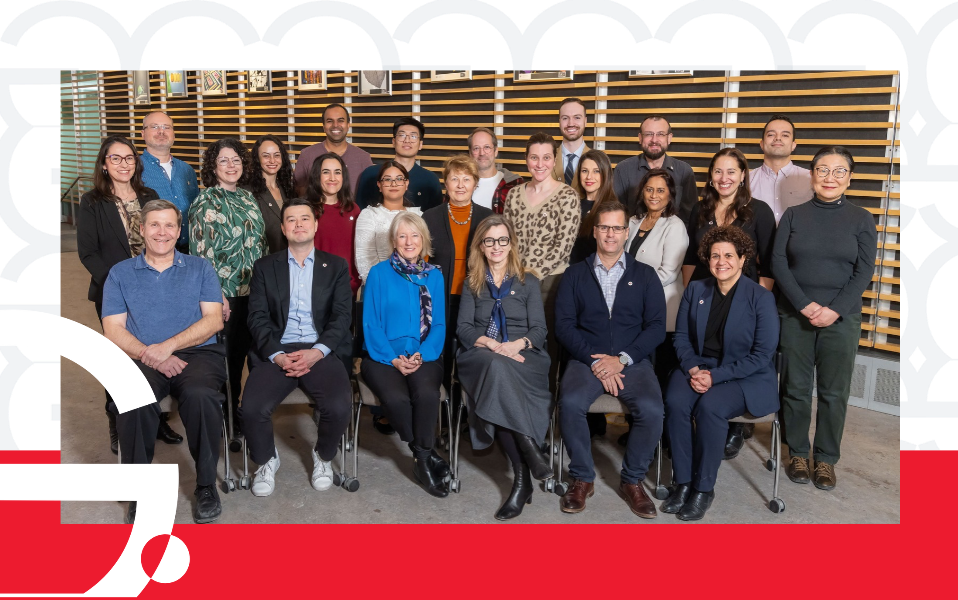
MOHCCN Phase II Announcement
McGill University, the Rosalind and Morris Goodman Cancer Institute, the Research Institute of the McGill University Health Centre, the Jewish General Hospital and Lady Davis Institute, as well as our partners across the Marathon of Hope Quebec (MOHQ) Consortium, are proud to be part of the second phase of the Marathon of Hope Cancer Centres Network (MOHCCN) announced on September 24, 2026, by the Terry Fox Research Institute and the Government of Canada.
The MOHCCN is a pan-Canadian initiative launched in 2019 that is transforming cancer research and advancing precision oncology across Canada. Building on the achievements of Phase I, which concluded in March 2026, this renewed federal investment will strengthen our capacity to develop and deliver personalized oncology for people with cancer across Canada and Quebec.
McGill Helping Shape the Future of Precision Oncology
Since 2020, researchers and clinicians across the McGill community have played a leading role in advancing MOHCCN’s mission. Work done by our teams has contributed to the generation of large genomic and clinical datasets. The MOHQ has sequenced tumour and matched normal samples and shared this genomic and clinical data from over 4500 patients, with more than half of these cases contributed by McGill clinicians and researchers. The tumours sequenced spanned a range of cancer types including breast, lung, prostate, pancreatic and biliary, gastric, ovarian, colorectal, oral and skin cancers, lymphomas as well as rare cancers and rare cancer subtypes.
Investigators from the McGill community also led several pan-Canadian projects that brought together clinicians and researchers from across Canada to address specific questions that would have been difficult to address without inter-provincial collaboration.
Twenty pan-Canadian projects were selected through a national competition focused on four priority areas, including drug resistance, dynamic biomarkers, molecularly guided treatment assignment, and rare or understudied cancers. Five of these projects were led by McGill principal investigators, including Armen Aprikian, Simone Chevalier, Morag Park, Jonathan Spicer, Simon Tanguay, and Ian Watson. An additional five projects benefited from key participation by our faculty, including Mark Basik, Melica Nourmoussavi Brodeur, Susie Lau, Nader Sadeghi and George Zogopoulos.
In addition to leading pan-Canadian projects, McGill Investigators also led regional cohorts that contributed to the MOHCCN dataset. Faculty members whose contribution focused primarily on regional cohorts include Gerald Batist, Lorenzo Ferri, William Foulkes, Livia Garzia, Nathalie Johnson, Wassim Kassouf, Petr Kavan, Philippe Lefrançois, Catalin Mihalcioiu, Jean-Sébastien Pelletier, Alan Spatz, Sabrina Wurzba.
McGill investigators secured two out of eight technology development grants awarded nationally to support deployment of novel technologies to advance precision oncology. George Zogopoulos, working with Ioannis Ragoussis, investigated how long-read sequencing of germline DNA can reveal disease-associated mutations in cancer susceptibility genes that traditional short-read sequencing may miss. Morag Park and her team leveraged spatial transcriptomics and advanced computational approaches to examine spatial gene expression of metaplastic breast cancer, a rare and aggressive form of breast cancer.
Ian Watson led one of five funded MOHCCN Data Sharing and Use Pilot projects. In collaboration with Guillaume Bourque, Hamed Najafabadi, and Yasser Riazalhosseini, his group leveraged MOHCCN datasets to identify low-frequency driver mutations that could be crucial for improved cancer diagnosis and treatment selection in melanoma.
Clinician Scientist Awards were awarded to 4 early career clinician scientists based at McGill-affiliated hospitals, including Philippe Lefrancois, Basile Tessier Cloutier, Simon Roy, and April Rose. Parsa Bagherzadeh and Emmanuelle Rouselle both received inaugural MOHCCN Health and Informatics awards.
Leaders in sequencing technologies, bioinformatics and large-scale genomic analysis, researchers at the Victor Philippe Dadahleh Institute for Genomic Medicine at McGill University were instrumental in building the pipeline for generating and analyzing the genomic data that will help us better understand cancer and develop new personalized treatment approaches in the future. Led by McGill Professor Guillaume Bourque, the Canadian Centre for Computational Genomics (C3G) team analyzed over 2.9 petabytes of data and developed the infrastructure that allows us to securely share data across institutions nationwide. Complementing the genomic and bioinformatic efforts, teams at the RI-MUHC, led by David Buckeridge, and at the Jewish General Hospital contributed to integrating and linking clinical data with the genomic data generated.
In addition to their scientific contributions, McGill Faculty have played an integral role in MOHCCN leadership, governance and patient engagement. Among them, cancer researchers and cancer survivors Nicole Beauchemin and Nathalie Lamarche-Vane served as the inaugural co-chairs of the MOHCCN patient working group. Together, they led a community of 34 people with lived and living experience of cancer from across Canada, ensuring that patient perspectives informed and advanced the network’s priorities, activities and decision-making.
Operational teams behind the success
McGill serves as one of the coordinating secretariats of the Marathon of Hope-Québec Consortium, supporting activities across participating institutions throughout the province. As Consortium Co-Lead, Morag Park has played a central role in bringing together researchers, clinicians and institutional partners to build a collaborative network across Quebec
While scientific and clinical leadership has been essential to building the network, a dedicated team of project managers, coordinators, and research and administrative staff across our participating institutions works behind the scenes to coordinate activities supporting everything from sample and clinical data collection to sample preparation, sequencing and analysis, data management, contracts, funding administration, and scientific and financial reporting. Their expertise and dedication ensure project milestones are met, funding conditions are fulfilled, and the MOH-Q operates efficiently across multiple institutions.
From the Montréal Cancer Consortium to the Marathon of Hope Québec
The foundation for MOHCCN in Québec began in 2018 with the Montréal Cancer Consortium (MCC), a Terry Fox-funded pilot project led by Ian Watson and John Stagg, who was then based at the CR-CHUM. By bringing together researchers and clinicians from two universities and four hospitals, the MCC demonstrated the feasibility and value of large-scale collaborations in precision oncology and immunotherapy.
Building on this success, the Québec Cancer Consortium (QCC) was launched in 2019, securing additional funding from the Ministère de l’Économie, de l’Innovation et de l’Énergie du Québec through the Fonds d’accélération des collaborations en santé (FACS) program to further strengthen biobanking activities, clinical data capture and sharing infrastructure, governance frameworks, and patient engagement.
The success of both the MCC and the QCC, as well as work done through the Réseau recherche sur le cancer, an FRQ-funded network, laid the groundwork for Québec's leadership within the MOHCCN, positioning the province and its investigators as key contributors to the network. Today, many Québec investigators serve on working groups, the steering committee and the network council. Their leadership reflects the collaborative culture, expertise and infrastructure developed through years of coordinated investment and partnership across the province.
Looking ahead to Phase II
As we launch Phase II of the MOHCCN, McGill and its affiliated hospitals, together with our partners at the Centre hospitalier de l’Université de Montréal, Hôpital Maisonneuve-Rosemont, Centre hospitalier universitaire de Québec-Université Laval, Institut universitaire de cardiologie et pneumologie de Québec, Centre hospitalier universitaire Sainte-Justine, Université de Sherbrooke and Centre hospitalier universitaire de Sherbrooke, look forward to continuing to contribute our expertise to this national initiative and expand access to precision medicine to people with cancer in Quebec and Canada.
We are grateful to the Government of Canada, the Terry Fox Research Institute, the Marathon of Hope Cancer Centres Network, funding partners and foundations, participating institutions, and the hundreds of investigators, research staff, administrators, and patients whose contributions make this endeavour possible. We also thank the Government of Québec and the ministère de l’Économie, de l’Innovation et de l’Énergie for their early investment through the FACS program, which helped build the infrastructure and partnerships that positioned Quebec to contribute meaningfully to the MOHCCN. Together, we are driving and shaping the future of cancer research and precision oncology in Quebec and Canada.


Rosalind & Morris Goodman Cancer Institute all rights reserved • Privacy policy • Accessibility
Website by Riposte