Science and art are often seen as two fields that rarely overlap — one analytical and precise, the other expressive and intuitive. Yet at their core, both disciplines share a common purpose: to help us see the world differently. This idea was at the heart of Science-meets-Art, an exhibit hosted by the Emerging Topics in Health (EtOH) seminar series and the Rosalind and Morris Goodman Cancer Institute (GCI).
The exhibit invited trainees and researchers to reimagine their science through an artistic lens. More than 50 works transformed McGill’s Bellini atrium into a gallery featuring stunning histology images, creative data visualisations, immunofluorescence of biological tissues, and even artistic installations.
Art as a New Way of Seeing Science
The exhibit was preceded by a thought-provoking EtOH seminar delivered by artist and sculptor Angela Palmer, whose work sits at the intersection of medical imaging, storytelling, and visual abstraction. In her talk titled Illuminating the Unseen: A Fusion of Art and Science, Ms. Palmer described how she carves MRI and CT scan slices and engraves each layer onto glass sheets, revealing a three-dimensional result. Her work was initially inspired by a model of the penicillin molecule created by Nobel-winning scientist Dorothy Hodgkin, made with a black pen and layers of acrylic. Palmer’s first piece, Brain of the Artist, displays her own brain, created from 16 glass sheets, each representing a section of her MRI scan. Her talk highlighted the beauty that lies within science and scientific research, and how strong emotions can be created by this unexpected intersection.
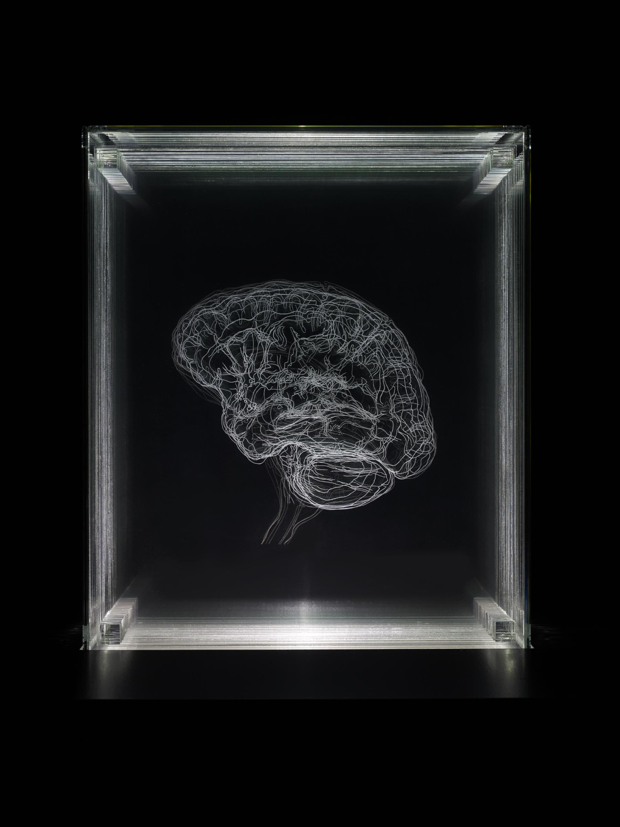
Brain of the Artist, Angela Palmer, © Angela Palmer, National Galleries of Scotland
Research Reimagined
The gallery that followed continued this dialogue between disciplines. Organized by Professors Daniela Quail, PhD and Judith Mandl, PhD, with GCI postdoctoral fellows Dakota Rogers, PhD, and Samuel Doré, PhD, the exhibition featured art whereby vibrant immunofluorescence images became landscapes of colour, histology slides appeared as architectural forms, creative data visualizations took on a sculptural presence, and even experimental installations invited viewers to reflect on scale, structure, and pattern.
For one of the organizers, Dakota Rogers, the motivation was clear:
“As scientists, we communicate through structured formats — posters, figures, presentations. But so much of our daily work contains an overlooked aesthetic. We wanted to create a space where researchers could highlight the artistry embedded in their science.”
When scientific images are removed from their analytical context, they become invitations to curiosity, reminding us that discovery is not only rigorous but also deeply creative.
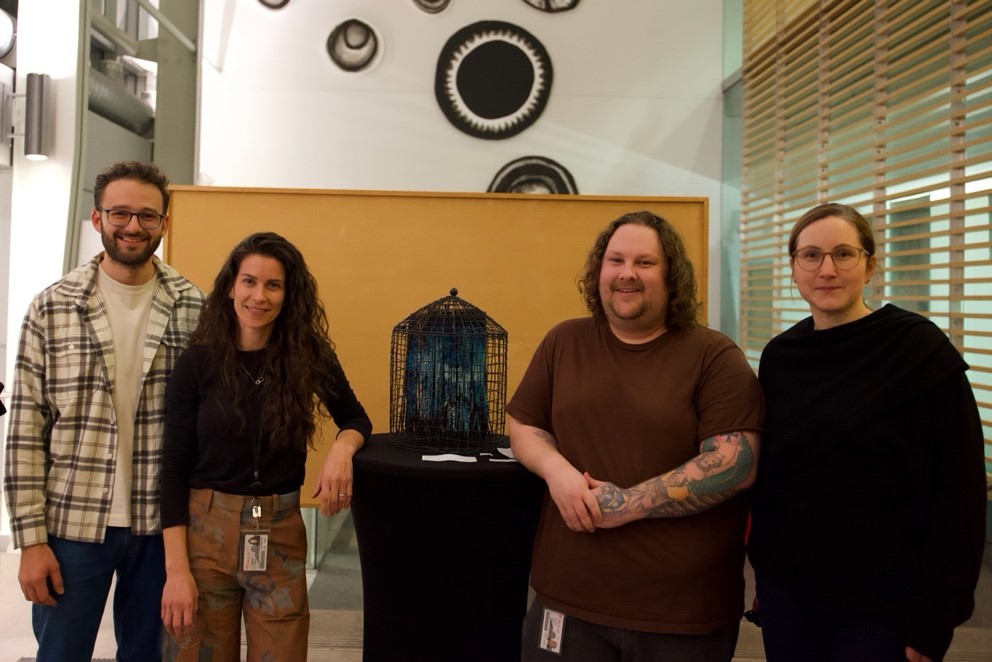 The Science-meets-art organizing committee from left to right: Samuel Doré, Daniela Quail, Dakota Rogers and Judith Mandl
Celebrating Creativity in Research
A People’s Choice Award crowned the evening, honouring the piece that best embodied the spirit of “science-meets-art.” This year’s winner, Susan Westfall, PhD, a postdoctoral fellow in Professor Irah King’s lab, presented a striking image, obtained during her routine tissue analysis, of an intestinal helminth embedded inside the muscle layer of the intestine. The ensemble looks like a smiley face. The piece sparked conversation, delight, and reflection, drawing praise from attendees and from Angela Palmer herself, who offered her an ancient rock she herself uses for her sculptures as a symbolic prize.
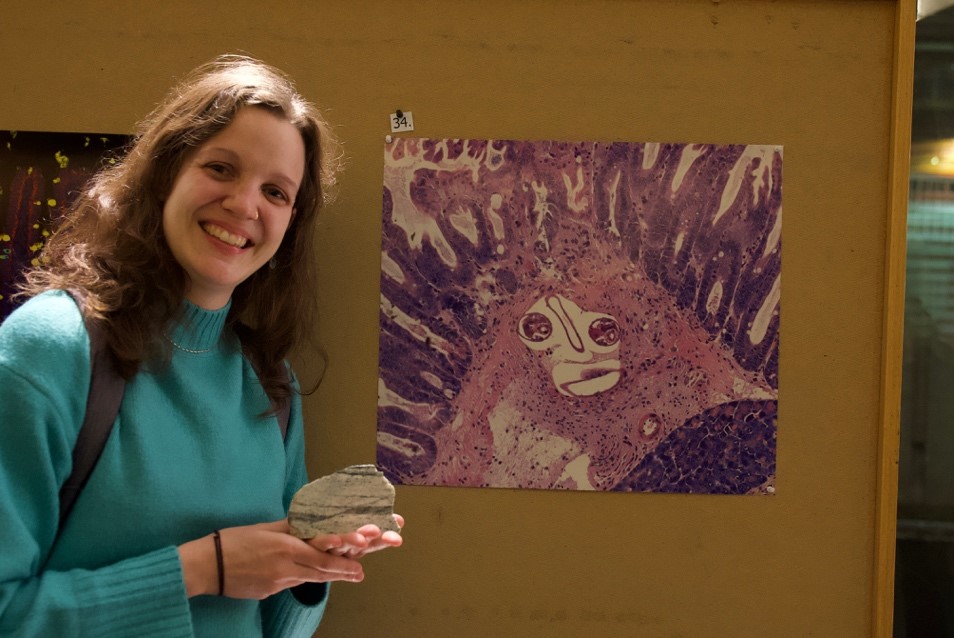 Winner Susan Westfall next to her winning piece
Overall, this unique event introduced a new take on the research that is done at the GCI and beyond, highlighting both beauty and creativity.

Rosalind & Morris Goodman Cancer Institute all rights reserved • Privacy policy • Accessibility
Website by Riposte