GCI-led study finds lab-grown tumours just as predictive of patient treatment response
July 22 2026
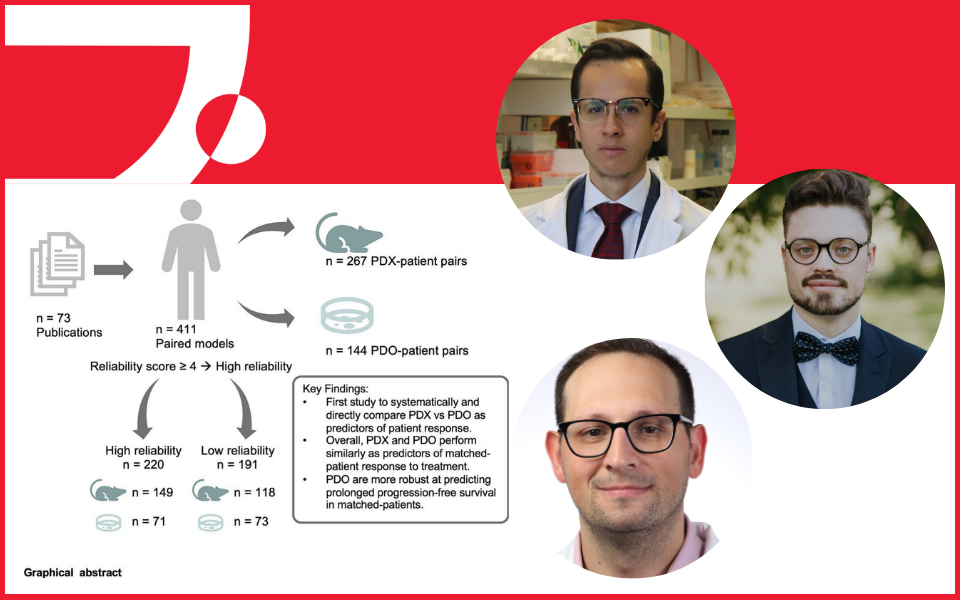
A team of more than a 15 researchers from the Rosalind & Morris Goodman Cancer Institute (GCI), with trainees driving much of the work from the ground up, has published a major systematic review and meta-analysis comparing two of the most widely used preclinical models in cancer research: patient-derived organoids (PDOs) and patient-derived xenografts (PDXs). Published in Cancer Treatment Reviews, the study provides the first large-scale comparison of how accurately these models predict patient responses to cancer therapies, offering new evidence that could influence how future treatments are developed and tested.
The project was led by MD-PhD students Joan Miguel Romero, Jamie Magrill and Matthew Dankner and brought together an exceptionally collaborative team of trainees, faculty, and international researchers spanning multiple disciplines.
What are these models?
The new study compares PDXs and PDOs generated from more than 400 patients with solid tumours who received the same anti-cancer therapies.
Both models start the same way: a small sample of the patient’s tumour is collected during surgery or biopsy.
A patient-derived xenograft (PDX) is created by implanting a patient’s tumour into a mouse, allowing researchers to observe how it responds to different therapies within a living organism. Because of the complex environment surrounding the tumour, a PDX can capture some of the more multifaceted aspects of tumour growth. However, they are a slow more expensive model with enduring ethical questions.
A patient-derived organoid (PDO) is grown entirely in the laboratory. Researchers culture tumour cells into miniature three-dimensional structures that preserve many of the biological characteristics of the original tumour. PDOs can be grown and tested much faster and efficiently than PDXs.
For years, researchers have debated which model is the better at predicting patient treatment response. The new analysis provides the strongest evidence to date that, in many settings, PDOs can be just as good.
The researchers found that PDOs predicted patient treatment responses with accuracy comparable to PDXs across hundreds of matched patient-model pairs. These findings suggest that organoids could replace animal models in many areas of preclinical cancer research, accelerating drug testing while reducing costs and animal use.
“This project shows that, in the right context, cells grown in a dish can be just as informative as animal models,” said Matthew Dankner, senior author of the study. “We hope these findings will encourage researchers to reduce reliance on animal testing without compromising the accuracy needed to develop new cancer therapie. Ultimately, this could help bring promising treatments to patients more efficiently. This work would not have been possible without the extraordinary collaboration of more than a dozen trainees from the McGill MD-PhD Program and the Goodman Cancer Institute.”
Beyond its scientific findings, the project highlights the strength of trainee-led research at the GCI. Driven by collaboration across laboratories and disciplines, the study demonstrates how team-based approaches can tackle important questions on the efficacy and ethics of cancer research.
To read the full study: Comparative analysis of patient-derived organoids and patient-derived xenografts as avatar models for predicting response to anti-cancer
The graphical abstract was adapted from the original study.

Rosalind & Morris Goodman Cancer Institute all rights reserved • Privacy policy • Accessibility
Website by Riposte