


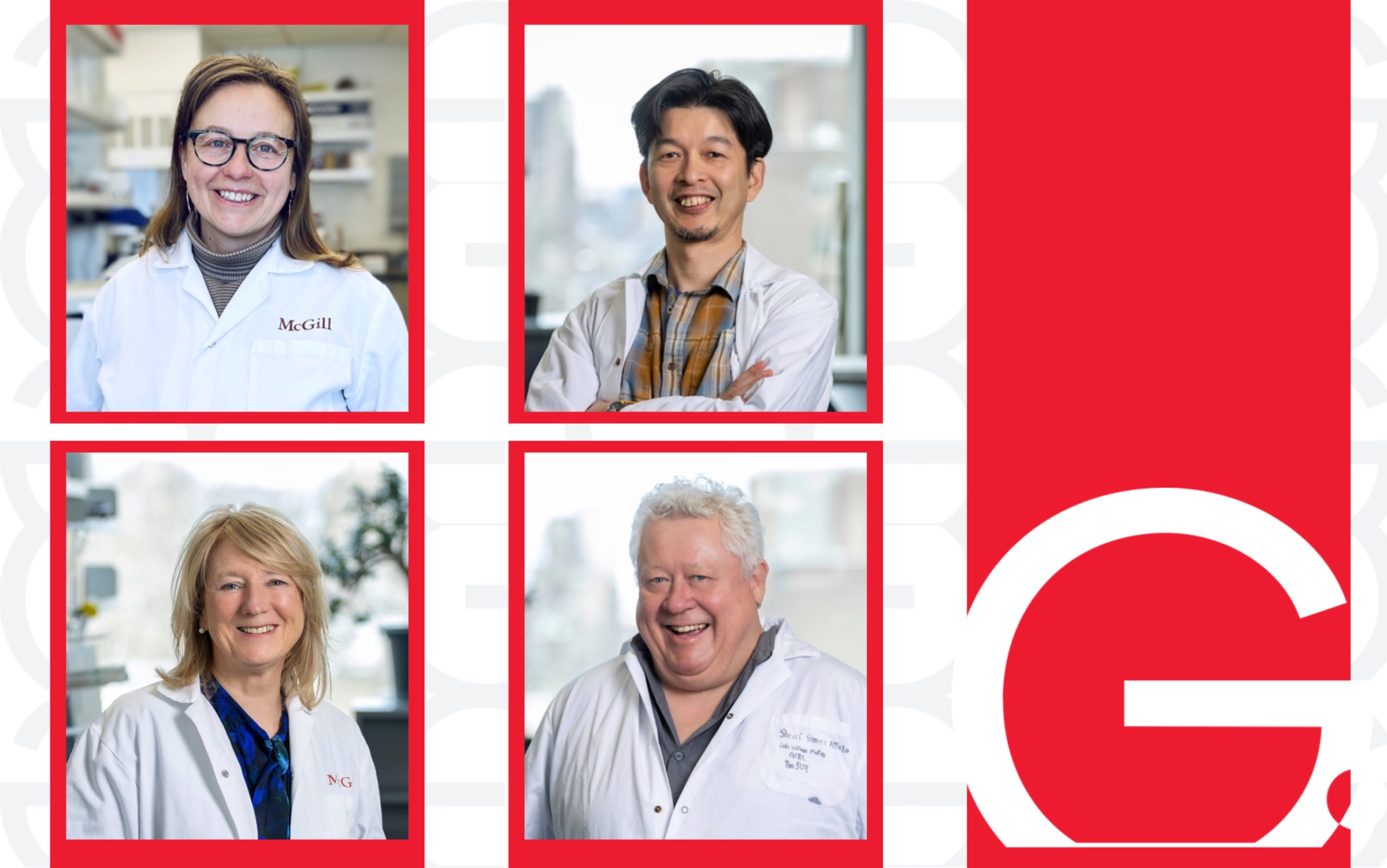
Four research teams from the Rosalind & Morris Goodman Cancer Institute (GCI) are among the recipients of the 2026 Cancer Research Society (CRS) Operating Grants. Representing a total investment of $13.9 million dollars over two years from the CRS, each research team will receive $140,000 in the next two years to improve cancer prevention, detection and treatment.
Yojiro Yamanaka – How the tumour microenvironment arises
The tumour microenvironment is composed of cells and other components and supports the tumour as it grows. Its role in cancer initiation and progression is well recognized, but how it initially arises remains unknown. This is the question Professor Yamanaka and his team aim to answer, thanks to the support from CRS and Ovarian Cancer Canada. Titled Elucidating the initiation of tumour microenvironment, the research project will study this question the context of ovarian cancer, with a specific focus on tissue-resident macrophages which are known as immune primary responders.
Heather Melichar – Tailoring immune checkpoint inhibitors
Immune checkpoint inhibitors have transformed cancer treatment, by allowing T cells to recognize cancer cells and kill them. In some cases, however, T cells start attacking healthy tissues potentially causing severe complications for patients. Professor Melichar’s project, titled Tracking the fate of self-reactive T cells after checkpoint blockade, will identify the different types of T cells and how they respond to therapy, to improve treatment efficiency in patients. Funded in collaboration with the RBC Urban BBQ, this project will bring together researchers from the GCI (John Stagg), the Lady Davis Institute (Marie Hudson), and Hôpital Maisonneuve-Rosemont (Ben Haley)
William Muller – The transition from in situ to invasive breast cancer
The transition from in situ to invasive breast cancer is a process that remains poorly characterized, and yet many patients will undergo this progression. Professor Muller recently published a study on the role of neutrophils, a type of immune cells, in accelerating this transition. Support from CRS will allow to build on this work and Evaluate the role of neutrophil elastase in progression of ductal carcinoma in situ to invasive breast cancer.
Morag Park – The barrier of treatment resistance in triple-negative breast cancer
Triple negative breast cancer (TNBC) is an aggressive form of breast cancer that often fails to respond to therapy. This is mainly due to a thick coat of tissue built around the tumour and prevents therapies from reaching the core of the tumour. Professor Park and her team have identified molecules that help strengthen this barrier and lead to treatment failure. Thanks to support from CRS and La Vie en Rose, they will investigate if these molecules could be targeted by other therapies to allow anti-cancer treatments to work more efficiently. This work will be done in collaboration with Hellen Kuasne, PhD (Research Associate in the Park lab), Dr. Sarkis H. Meterissian (McGill University Health Center) and Dr. Ozgur Sahin (Medical University of South Carolina)
These awarded projects highlight the potential and ambition of the research projects brought to life at the GCI, and how all researchers are working towards better outcomes for cancer patients.
Full press release: CRS website

Rosalind & Morris Goodman Cancer Institute all rights reserved • Privacy policy • Accessibility
Website by Riposte
